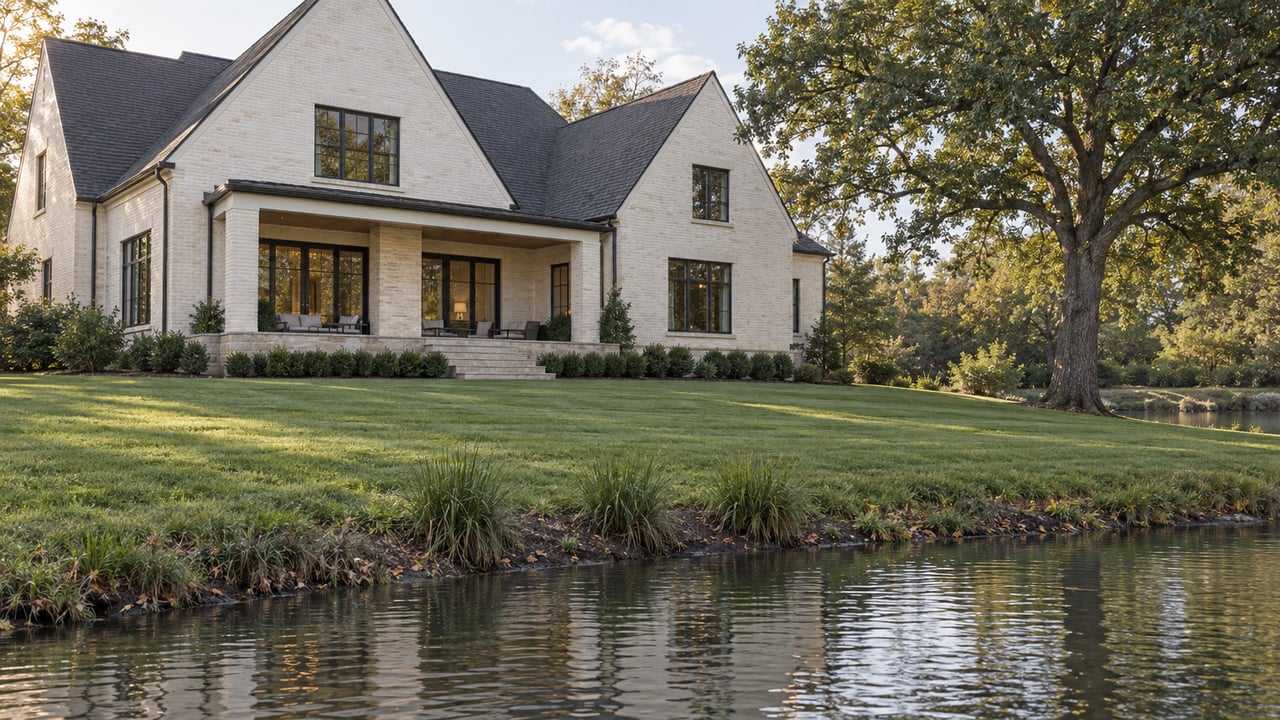
Walk the loop around Braemar Park on a cool September morning and you pass the lake first. It's the one with the marina, the boat launch, the dock where somebody's pontoon sits tied up under a gray sky. The neighborhood's materials describe it as an 80-acre spring-fed centerpiece, with three and a half miles of natural shoreline and water that's been stocked with bluegill and bass since the early 2000s.
Keep walking the trail past the tot lot and the community grill, and the woods thin out to reveal a second body of water. It's smaller, with no dock or marina, and it isn't listed on the neighborhood's amenities page. County land records describe the subdivision as having two lakes, and the trail passes the second one.
The main lake's amenities
The main lake earns its billing. It's fed by more than 30 live springs, which is why the neighborhood's own materials describe the water level as staying constant year round regardless of drought. Southeastern Pond Management handles the upkeep, and the depth runs deep enough to matter for anglers: an average of 15 feet, with the deepest point past 34.
The stocking has always been specific rather than generic. The original fill included 70,000 Coppernose Bluegill Bream and Red Ear Shellcrackers, plus 70,000 fathead minnows as forage, topped off with 7,000 F-1 Largemouth Bass and 700 catfish. That's not a lake somebody tossed a few fish into and hoped for the best. It's a managed fishery, closed to anyone who doesn't own property in the subdivision.
The rules on the water are just as specific. No jet skis or wave runners are permitted, and boats and pontoons are capped at 17 feet. Piers, docks, and boathouses go through architectural review before anyone builds one. Here's the quick version of what governs the main lake:
- Roughly 80 acres, with 3.5 miles of shoreline
- Fed by 30-plus live springs, maintained by Southeastern Pond Management
- Average depth 15 feet, deepest point over 34 feet
- No jet skis or wave runners
- Boats and pontoons limited to 17 feet
- Docks, piers, and boathouses require architectural review before construction
That last rule matters more than it looks. It's the reason the water stays as quiet as it does, and it's also the reason the second lake barely has any built structures on it at all.
The second lake
Public land listings for lots inside The Highlands mention a second lake almost in passing, grouped in with the marina and the walking path as part of the subdivision's amenity package. There's no acreage figure attached to it anywhere in the public record, no stocking history, no marina of its own. It sits inside the wooded stretch that the walking trail wraps around, which means most people who use the trail for exercise pass right by it without necessarily registering that it's a distinct feature and not just a bend in the same shoreline.
The published record treats the two lakes differently. The main lake comes with acreage, depth, stocking numbers, boating rules, and a marina. The second lake appears only as a line in the subdivision's list of features, with no figures attached, so what it offers is best learned by walking out to it.
Braemar Park is what actually connects the two
Braemar Park sits between them, and it's the piece of common ground that turns two separate bodies of water into one continuous loop. The park's amenities are laid out plainly in the neighborhood's own materials: open grassy areas, a basketball court, swing sets, a pavilion with a community grill, and a walking trail that circles the park itself.
The trail's exact length depends on which source you check. The neighborhood's own amenities page lists it at three-quarters of a mile. A separate land listing for a Highlands lot describes a full mile of paved path. The discrepancy probably comes down to whether the measurement includes the connector stretches out toward the second lake or just the loop immediately around the park. Either way, it's tree-lined for its entire length, which is the one detail every source agrees on.
The Cottages section, a cluster of homes generally running 2,000 to 2,800 square feet, sits close enough to Braemar Park that its residents get the same walking-distance access to the grill and the trail as anyone on a five-acre estate lot elsewhere in the subdivision. That's worth knowing if you've ever wondered why the smaller homes near the park entrance always seem to have somebody out walking a dog at dusk. They're the closest rooftops to the amenity that ties the whole layout together.
New lines are still being drawn on the plat
The Highlands isn't a finished product frozen in whatever year the marketing photos were taken. Lafayette County property transfer records, published regularly by the Oxford Eagle, show lots inside the subdivision continuing to change hands. In the transfer week of February 23-27, 2026, Shady Creek Properties LLC conveyed Lot 135 to Wilson and Lauren Parry. Earlier transfers on record include Lot 107 going to William and Margaret Mounger, Lot 74 to Dustin and Joie Blount, and Lot 73 to Ross Straughan.
That steady churn of lot-level transfers is a better read on how active the subdivision still is than any single listing price. Somebody is clearing a lot near you right now, and the plat number on the deed is the only way to know exactly where until the framing goes up. If you've noticed new construction equipment near one of the wooded lots off Highlands Circle or Braemar Park Drive this year, the county's own transfer records are the place to confirm it rather than guessing from the road.
Two lakes, two sets of details
For the main lake, the public details are specific: a marina with a boat launch, a 17-foot boat limit, no jet skis, and a fishery stocked with named species. For the second lake, the public details stop at its existence within the subdivision. Anyone curious about it has to go to the source, which in this case is the trail itself.
For anyone who's lived here long enough to have their own routine around the trail, that split explains a lot about how the two ends of the loop feel different from each other. The marina side has motion: boats going out, docks getting used, the occasional weekend crowd near the launch. The far side, past the tot lot and the tree line, is just water and woods with no infrastructure asking anything of you.
Together, the two lakes give the trail loop a distinct change of pace.
If you've got a specific question about where your lot sits relative to either lake, what the architectural review process looks like for a dock or a build, or how a recent Highlands transfer compares to what's happening on your own street, Noelle Goubeaux knows this subdivision's plat lines well enough to walk you through it.
This article is general information, not legal, tax or financial advice. Consult a qualified professional about your situation.